
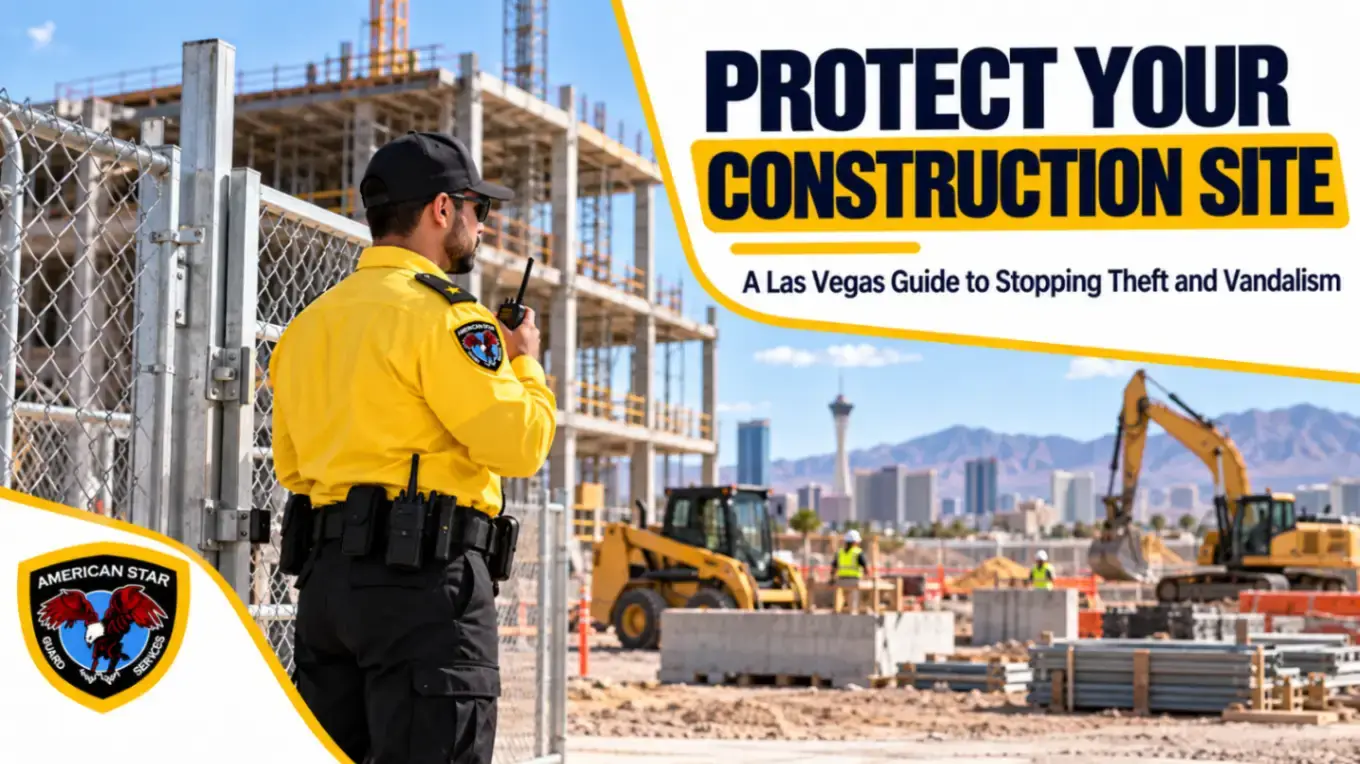
Monday morning on a jobsite in Henderson. The crew shows up and the skid steer is gone. So are 400 feet of copper wire that went into the walls on Friday. The schedule just slipped a week and nobody has even called the insurance company yet.
If you want to know how to protect a construction site from that kind of Monday, this guide walks through it step by step. Construction site security means using fencing, lighting, guards, patrols and cameras to keep equipment, materials and people safe from the day ground breaks until the keys are handed over.
Why Las Vegas construction sites are targets for theft
Thieves go where the opportunity is. The National Equipment Register has noted for years that equipment theft rises in areas going through a building boom, because more machines on more sites means more chances to steal. The Las Vegas valley fits that pattern, with active projects stretching from the Strip to Summerlin, Henderson and the northwest.
Construction sites are also easy targets by design. They are open lots with temporary fencing, few neighbors and nobody around from 5 p.m. to 6 a.m. Tools, wire and fuel sit out in the open. Many machines still start with common keys.
Most jobsite theft happens after hours and on weekends. A three-day holiday weekend gives a thief plenty of time to load a trailer without anyone noticing.
The real cost of jobsite theft and vandalism
The National Insurance Crime Bureau estimates that equipment theft costs U.S. owners between $300 million and $1 billion a year. The National Equipment Register puts the average loss from a single equipment theft at about $30,000.
That number only covers the machine. The bigger bill usually comes after:
- Delays. Your crew sits idle while you rent a replacement or wait for new materials. On a tight schedule, a lost week can trigger penalty clauses.
- Insurance. Every claim pushes your premiums and deductibles up at renewal.
- Rework. When thieves rip copper out of finished walls, you pay to replace the wire and to repair the drywall around it.
- Liability. If a trespasser gets hurt falling into an open trench on your site, you may be the one facing a lawsuit.
A general contractor running a $3 million build can lose more to one bad weekend than a full month of security would have cost.
Common security risks on construction sites
Every site is different, but the same five problems show up again and again.
Equipment and tool theft
Skid steers, mini excavators, generators and light towers are the usual targets. They are easy to load on a trailer and easy to resell. Small power tools disappear even faster because they fit in a backpack.
Copper and material theft
Copper wire, plumbing pipe, lumber and appliances waiting to be installed are all worth money. Late-stage projects are hit hardest because the most valuable materials are already on site and in the walls.
How to deal with construction site vandalism
Graffiti, broken windows, slashed tires and damaged equipment all count as vandalism. When it happens, move fast:
- Report it to police the same day and get a report number for your insurer.
- Document everything with dated photos and video before anyone cleans up.
- Repair quickly. Graffiti left up for a week invites more of it.
- Find the gap. Look at how they got in. A cut fence or a dark corner tells you where to add lighting or patrols.
- Add coverage for the next few weeks. Vandals often come back to the same site.
Trespassing and squatting
Unfinished buildings attract people looking for shelter, especially during cold desert nights. Trespassers can damage work, start fires for warmth or get hurt on your site.
Fire hazards from hot work
Welding, cutting and torch work throw sparks that can smolder for hours after the crew leaves. A fire in a wood-frame building under construction can spread fast because walls are still open.
Security guards vs mobile patrol vs cameras: which fits your site?
You have three main tools. Each one solves a different problem.
| Option | Best for | Strengths | Limits |
|---|---|---|---|
| On-site security guard | Large sites, high-value equipment, late-stage builds | Constant presence, gate control, immediate response | Highest cost per month |
| Mobile patrol | Small or mid-size sites, tighter budgets | Random checks, lower cost, covers several sites | Gaps between visits |
| Construction site surveillance | Recording evidence, watching remote corners | Works 24/7, helps with insurance claims | Needs a person to respond in real time |
Cameras alone rarely stop a theft in progress. A thief with a hoodie and a box truck can be gone before anyone checks the footage. Construction site surveillance works best when the alert goes to someone who can show up.
For most Las Vegas projects, a layered approach makes sense:
- Under $1 million or early stage: fencing, lighting and mobile patrol security with two or three random visits per night.
- $1 to $10 million or framing stage: cameras plus mobile patrol, with an overnight guard on weekends.
- Large or late-stage projects: an on-site guard every night, with cameras covering the far edges of the lot.
These tiers are a starting point. Your actual plan should match your site layout and what is sitting on it each week.
How construction security guards protect your jobsite
A construction security guard does a lot more than sit in a truck at the gate. Here is what a typical night shift covers:
- Gate control and sign-in logs. Every crew member, vendor and delivery driver is logged in and out. If a pallet of tile goes missing, you know who was on site.
- After-hours patrols. The guard walks the perimeter, checks fence lines and looks inside open structures on a varied schedule. Every round is GPS-tracked and time-stamped.
- Equipment checks. At the start and end of each shift, the guard confirms that machines, trailers and tool boxes are where they should be and locked.
- Incident reports. If something happens, you get a written report with photos the same night, not a phone call on Monday.
- Police contact. Guards call police right away and stay on scene to give officers what they need.
Here is a real-world pattern we see often. A builder leaves a site open on Saturday and Sunday because the crew only works weekdays. Losses keep showing up on Monday. Adding a guard from Friday at 5 p.m. to Monday at 6 a.m., the riskiest 61 hours of the week, closes that window without paying for full-time coverage.
Good security for construction sites also protects your schedule. Fewer losses mean fewer reorders, fewer insurance claims and fewer days your crew stands around waiting.
Starting a project or already dealing with theft? Request a free site assessment and we will walk your jobsite with you, or call (702) 895-7399. Learn more about our construction site security services.
Fire watch for construction projects in Las Vegas
Some projects need a trained person whose only job is to watch for fire. This is called fire watch. It is often required in two situations:
- Hot work. After welding, cutting or torch work, someone must watch the area for smoldering sparks. Fire codes commonly require this watch to continue after the work ends.
- Impaired fire systems. When sprinklers or alarms are offline during construction or a tie-in, the fire marshal can require a fire watch until the system is back in service.
A fire watch officer patrols the area, keeps a log of each round, checks that extinguishers are ready and calls the fire department at the first sign of trouble. Skipping a required fire watch can lead to a stop-work order or fines.
Requirements vary by project and jurisdiction, so confirm them with your fire marshal. Our fire watch services in Las Vegas can usually be added to your existing site security plan.
How to prevent construction site theft: a step-by-step checklist
Use this checklist before ground breaks and review it at each new phase of the project.
- Fence the full perimeter. Use 6-foot fencing with privacy screen so thieves cannot see what is inside. Check it daily for cuts.
- Limit entry to one gate. One locked gate is far easier to watch than three.
- Light it up. Put motion-activated lights on equipment yards, material storage and the gate. Dark corners invite trouble.
- Post signs. “Monitored by security” and “No trespassing” signs make a thief think twice.
- Lock down equipment. Park machines in a tight group inside the fence. Remove keys, lower buckets and use wheel locks or track locks.
- Mark and track your gear. Engrave tools with your company name. Add GPS trackers to high-value machines and register serial numbers with the manufacturer.
- Schedule deliveries just in time. Copper and appliances sitting on site for two weeks are an open invitation. Have them delivered close to install day.
- Keep a sign-in log. Track every worker, vendor and visitor by name and time.
- Set an after-hours contact plan. Make sure your guard, superintendent and police non-emergency number are all on one sheet.
- Add guards or patrols for high-risk periods. Weekends, holidays and the weeks when copper and appliances arrive need extra coverage.
Breaking ground soon? Security costs less to plan before the first machine arrives than after the first theft. Book your free site assessment now.
How to choose a construction security company in Las Vegas
Construction security is its own skill. A guard who works a quiet office lobby may not know what to watch for on an active jobsite. Ask these questions before you sign:
- Are you licensed by the Nevada PILB? Every security company in Nevada needs a license from the Private Investigators Licensing Board. Our guide explains how to verify a Nevada PILB license.
- Have your guards worked construction sites before? They should know how to check equipment, spot a cut fence and recognize which materials are worth stealing.
- How will I get reports? Look for GPS-tracked patrols and digital incident reports with photos. You should know what happened overnight before your superintendent’s first coffee.
- Can coverage change as the project moves? A site needs light coverage during grading and heavier coverage once copper and appliances arrive. Your contract should flex with the build.
- Do you offer fire watch? Using one company for guards and fire watch keeps scheduling and billing simple.
For more questions to ask, read our guide on choosing a security company in Las Vegas.
FAQs about construction site security
How much does construction site security cost in Las Vegas?
Cost depends on the size of the site, the hours you need covered and whether you choose a guard, mobile patrol or both. Mobile patrol costs less than an overnight guard. Most contractors get the best value from a mix. Our guide to planning a commercial security budget can help you set numbers before you request quotes.
Do I need a guard 24/7 or only after hours?
Most sites only need coverage when the crew is gone, usually from evening until morning plus weekends. During the workday your superintendent and crew act as eyes on the site. Busy sites with constant deliveries sometimes add a daytime guard at the gate to control who comes in.
Are armed guards needed on construction sites?
Usually not. Unarmed guards handle most jobsites well. Armed coverage can make sense if your site has had repeat break-ins, stores very high-value equipment or sits in an area with violent crime. Compare both options on our armed and unarmed security officers page.
When is fire watch required on a jobsite?
Fire watch is commonly required during and after hot work such as welding and cutting. It can also be required when sprinklers or fire alarms are out of service. The exact rules depend on your project and local fire code, so confirm requirements with your fire marshal before work starts.
What is the best way to protect a construction site at night?
Combine strong fencing, bright motion lighting and a human response. Lock equipment inside the fence and remove keys. Then add either an overnight guard or random mobile patrols. Cameras help, but they only stop theft when someone is ready to respond to the alert right away.
Protect your jobsite before the next theft
Knowing how to protect a construction site comes down to layers: a solid perimeter, locked equipment and a person who shows up when something looks wrong. Each layer you add makes your site a harder target than the one down the street.
American Star Guard provides licensed construction site security services across Las Vegas and Southern Nevada. Request a free quote or call (702) 895-7399 to get a plan built around your project.
Sources
- NICB estimate of $300 million to $1 billion in annual equipment theft losses (Construction Junkie, citing NICB and NER)
- NER average cost of a single equipment theft at $30,000 (Deep Sentinel, citing NER)
- NER 2015 Equipment Theft Report (on theft rising in construction boom areas)