Las Vegas hosts some of the largest conventions and trade shows in the world. Tens of thousands of attendees, millions of dollars of exhibitor inventory, VIP speakers, product launches, and round-the-clock activity all come together inside massive venues and surrounding resorts. For event organizers, that scale is an opportunity, and it is also a security challenge.
Convention security in Las Vegas is not simply a matter of putting a few guards at the door. Every venue has its own rules, every show has its own risk profile, and Nevada has specific licensing requirements for the companies and individuals who provide security. Organizers who plan early and thoroughly protect their attendees, their exhibitors, and their reputation. Those who do not often discover the gaps at the worst possible time.
This guide walks through what event organizers, show managers, and exhibitors need to plan for, from early risk assessments to move-out. It is general planning information, and your venue contract and local authorities will define your specific obligations.
Why Las Vegas Events Have Unique Security Needs
Las Vegas is unlike most convention cities. Understanding those differences helps you plan realistically.
Scale and Density
Major shows fill hundreds of thousands, sometimes millions, of square feet, with crowds moving between halls, hotels, shuttles, and parking. Congestion, long lines, and multiple entrances create pressure points for crowd control.
24/7 Environment
The city never really sleeps. Attendees travel between the venue, casinos, restaurants, and nightlife at all hours. Your security concerns extend beyond show hours to exhibitor move-in, evening receptions, and after-parties.
High-Value Exhibits
Trade shows in technology, jewelry, cannabis, firearms accessories, automotive, and consumer electronics often display valuable or sensitive products. Exhibitors bring inventory, prototypes, and equipment that are attractive to thieves.
Mixed Venues and Jurisdictions
Some events take place in a dedicated convention center, others inside resort properties, and many span several venues. Each may have its own security team, rules, and contractors. Clear coordination is critical.
Visibility and Media
Events in Las Vegas draw press, influencers, and public attention. An incident that might be minor elsewhere can become a headline.
Start With a Security Risk Assessment
Before you hire anyone, define what you are protecting and from what. A structured assessment should look at:
- The venue. Layout, entrances and exits, loading docks, back-of-house areas, parking, and adjacent properties.
- The audience. Expected attendance, demographics, VIPs, and any controversial speakers or exhibitors.
- The exhibits. Value and sensitivity of products and data on display.
- The schedule. Move-in and move-out, show hours, evening events, and any off-site functions.
- Known risks. Theft, unauthorized entry, credential fraud, protests, medical emergencies, overcrowding, and disruptive behavior.
- Past incidents. Lessons from previous editions of your event or similar shows.
The assessment produces a security plan with staffing levels, post locations, and procedures that match your specific event. A professional provider such as American Star Guard can conduct or contribute to this assessment as part of event security planning.
Core Security Services for Conventions and Trade Shows
Access Control and Credential Checking
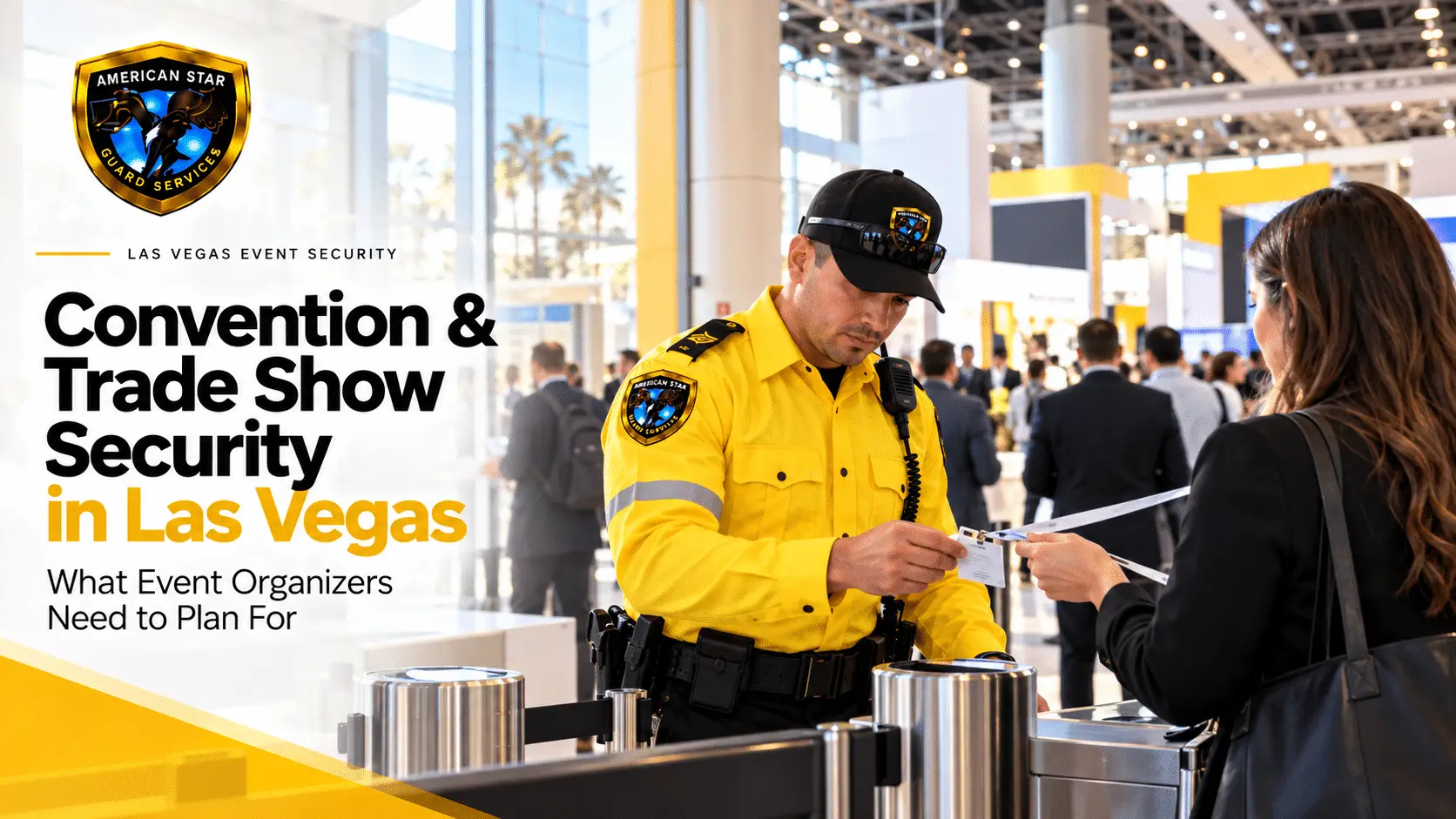
Controlling who enters is the foundation of event security. Officers verify badges at entrances, halls, VIP areas, and exhibitor-only zones. They identify counterfeit or shared badges, manage will-call and registration areas, and direct attendees who need assistance.
Consider dividing access by credential type: attendees, exhibitors, press, speakers, VIPs, staff, and vendors. Each should be visually distinct and clearly understood by security personnel.
Crowd Management
Large crowds require trained personnel to manage flow safely. That includes queue management, monitoring density near doors and popular booths, directing traffic in hallways, and coordinating with venue staff for keynote sessions or product launches that draw crowds. Fire and life safety rules limit how many people can occupy a space, and your venue or the local fire authority may require crowd managers for certain assembly events.
Exhibit Hall and Booth Security
Exhibitors depend on you to protect their inventory. Overnight security in exhibit halls, monitored move-in and move-out, and patrols during show hours all reduce theft. Some exhibitors will ask for dedicated booth guards for very high-value items, which can be arranged separately.
Loading Dock and Freight Security
Move-in and move-out are among the highest-risk periods. Freight, crates, and equipment come and go, and unauthorized people can slip in with a delivery. Officers control dock access, verify deliveries, and log high-value items.
VIP and Executive Protection
Keynote speakers, celebrities, executives, and government officials often require additional protection. This may include advance planning, escorts, secured green rooms, and controlled routes through the venue. Executive protection is a specialized skill and should be provided by qualified personnel. See our executive protection services.
Uniformed Patrol
Visible patrols throughout the venue deter theft, disorder, and unauthorized entry. Officers are also the first responders for lost children, medical issues, and attendee questions.
Emergency Response Support
Your security team should know the venue’s emergency procedures, including evacuation routes, medical response, and communication with venue security and public safety. Medical incidents are the most common emergencies at large events, and quick access to first aid and paramedics matters.
After-Hours and Overnight Security
Exhibit halls and staging areas need protection when the show is closed. Overnight officers monitor entrances, patrol aisles, and respond to alarms.
Parking and Transportation
Parking lots, shuttle stops, and rideshare zones need attention, both for safety and for traffic flow. Officers can direct vehicles, watch for suspicious activity, and assist attendees.
Nevada Licensing: What Organizers Must Verify
Nevada regulates private security through the Private Investigators Licensing Board (PILB), operating under Nevada Revised Statutes Chapter 648. Any company providing security guard services in Nevada must be properly licensed, and the individual officers must hold the required registration or work card.
For an event organizer, this is a critical compliance point. Hiring an unlicensed company, or using an out-of-state firm without proper Nevada authorization, can put your event, your insurance, and your reputation at risk. Before you sign a contract:
- Ask for the company’s Nevada license number and confirm it with the PILB
- Verify that the company is licensed for the type of service you need
- Confirm that officers hold current registrations
- Request proof of liability insurance
We cover this in more detail in our guide on how to verify a Nevada security company is properly licensed.
Coordinating With the Venue and Local Authorities
Every major Las Vegas venue has its own rules, and you must work within them.
Venue Security Policies
Convention centers and resorts often have in-house security and exclusive or preferred vendor arrangements. Some require that outside security companies be approved in advance, provide certificates of insurance, and follow venue-specific procedures. Read your venue contract carefully and ask early about:
- Whether outside security is permitted, and if so, any approval process
- Minimum staffing requirements set by the venue
- Restrictions on weapons, including for armed officers
- Communication protocols with venue security and dispatch
- Rules for loading docks, freight, and after-hours access
Fire Marshal and Life Safety
Occupancy limits, exit access, and crowd manager requirements are set by fire and life safety authorities. Your security team should know those limits and support enforcement.
Metro and Local Law Enforcement
For high-profile events, you may coordinate with the Las Vegas Metropolitan Police Department or other agencies. Private security supports but does not replace public safety. Make sure your security lead knows whom to call and how to escalate.
How Many Security Officers Will You Need?
There is no universal formula. Staffing depends on attendance, venue size, number of entrances, exhibit value, and risk level. Factors that drive numbers include:
- Number of access points to be staffed at all times
- Square footage and number of halls or rooms
- Peak attendance times, such as opening day or keynote sessions
- Number of VIP or restricted zones
- Overnight coverage requirements
- Event type, since a consumer show with a large public audience differs from an invitation-only industry meeting
A good security partner will build staffing by day and time rather than using a flat headcount. Expect more personnel at opening, during peak hours, and at move-in and move-out, and fewer during quiet periods.
Budgeting for Convention Security
Security costs typically include officer wages, supervision, uniforms, equipment, insurance, and administrative overhead, all reflected in the hourly bill rate. Nevada rates depend on market conditions, and demand spikes during major conventions, so early booking matters.
Ways to manage budget responsibly:
- Book early. Large events compete for the same pool of qualified officers.
- Define the scope clearly so you are not paying for unnecessary posts.
- Use a phased approach with heavier staffing at peak times.
- Combine technology and people, such as camera coverage of low-risk areas.
- Avoid the cheapest bid by default. Understaffed or poorly trained teams create risks that cost more later.
Get written proposals that itemize posts, hours, rates, supervisor coverage, and any additional fees such as overtime, holidays, or minimum shift lengths.
Security Tips for Exhibitors
Organizers can help exhibitors protect themselves by sharing guidance in the exhibitor manual. Useful advice includes:
- Never leave valuable items unattended, even briefly
- Keep small, high-value items locked or removed at night
- Use booth staff to watch for suspicious behavior
- Inventory equipment at move-in and move-out
- Report theft immediately to show security
- Protect data on laptops, tablets, and demo devices
- Be cautious about badge sharing
Providing a clear reporting process for lost or stolen items also helps your team respond quickly.
Common Convention Security Mistakes
- Planning too late. Last-minute hiring limits your options and quality.
- Ignoring credential control. Loose badge checking allows unauthorized entry.
- Underestimating move-in and move-out. These periods have high theft risk.
- Failing to brief officers. Guards need to know the layout, schedule, VIPs, and escalation contacts.
- Not coordinating with venue security. Duplicated or conflicting roles cause confusion.
- Skipping licensing verification. This exposes your event to compliance and insurance problems.
- No communications plan. Radios, phone trees, and a clear command structure are essential.
Building a Security Timeline
A simple planning timeline helps organizers stay ahead.
Three to six months before the event: Review your venue contract, define security needs, request proposals, and verify vendor licensing and insurance.
One to three months before: Finalize the security plan, staffing schedule, credential system, and emergency procedures. Hold walkthroughs with the venue.
One to two weeks before: Brief the security supervisor, confirm staffing, and distribute contact lists and post orders.
During move-in: Control the docks, verify exhibitor credentials, and begin overnight coverage.
During the show: Maintain visible presence, monitor crowd conditions, hold daily debriefs, and adjust staffing based on attendance.
During move-out: Continue strong access control, and watch for theft as exhibitors pack.
After the event: Review incident reports, collect feedback, and record lessons learned for next time.
What to Look for in a Las Vegas Event Security Company
When you compare providers, look for the following:
- A current, verifiable Nevada PILB license
- Experience with conventions and large events, not just static posts
- Trained officers with event-specific and customer-service skills
- Strong supervision and a clear chain of command
- The ability to scale staffing up and down quickly
- Professional appearance and communication
- Insurance coverage that meets venue requirements
- Written incident reporting and post-event summaries
- References from comparable events
American Star Guard provides security guard services in Las Vegas for events, businesses, and organizations, backed by Nevada licensing and a focus on responsive, professional service. To discuss your event, request a security proposal.
Frequently Asked Questions
Do I need licensed security for a convention in Las Vegas?
Yes. Companies providing security guard services in Nevada must be licensed through the Private Investigators Licensing Board, and officers must hold the appropriate registration. Always verify this before signing a contract, and check your venue’s specific requirements.
How far in advance should I book convention security?
As early as possible, ideally several months ahead for large events. Las Vegas has a heavy convention calendar, and qualified staff are in high demand during peak weeks.
Can outside security companies work inside major Las Vegas venues?
Many venues allow outside security but require approval, insurance certificates, and coordination with in-house teams. Some venues have exclusive arrangements. Check your contract early.
Should convention security officers be armed?
Most convention security is unarmed. Armed officers may be considered for high-risk situations, but venues often restrict weapons, and armed service brings additional licensing and insurance requirements. Discuss it with your venue and security provider.
How much does trade show security cost?
Cost depends on the number of officers, hours, supervision, and market demand. Request itemized proposals so you can compare scope, not just hourly rate.
What is the biggest security risk at a trade show?
Theft of exhibitor property is one of the most common issues, along with unauthorized access and crowd-related problems. Move-in and move-out are especially vulnerable, so plan coverage for those periods.
Can security help with medical emergencies?
Officers are often first on scene and can call for paramedics, provide basic assistance within their training, and manage the area. Coordinate with the venue’s medical response plan.
Final Thoughts
Convention and trade show security in Las Vegas comes down to preparation. Assess your risks, verify Nevada licensing, coordinate closely with the venue, staff to the real schedule, and choose a provider with proven event experience. When those pieces are in place, attendees feel safe, exhibitors feel protected, and your team can focus on running a successful show.
If you are planning an upcoming event, contact American Star Guard to talk through your needs and build a security plan that fits your venue and your budget.
Related reading: Nevada PILB Licensing Explained | Event Security Services | Executive Protection
More from American Star Guard: Executive Protection for Events in Nevada | How to Choose the Best Security Company in Las Vegas | Access Control | Hospitality Security