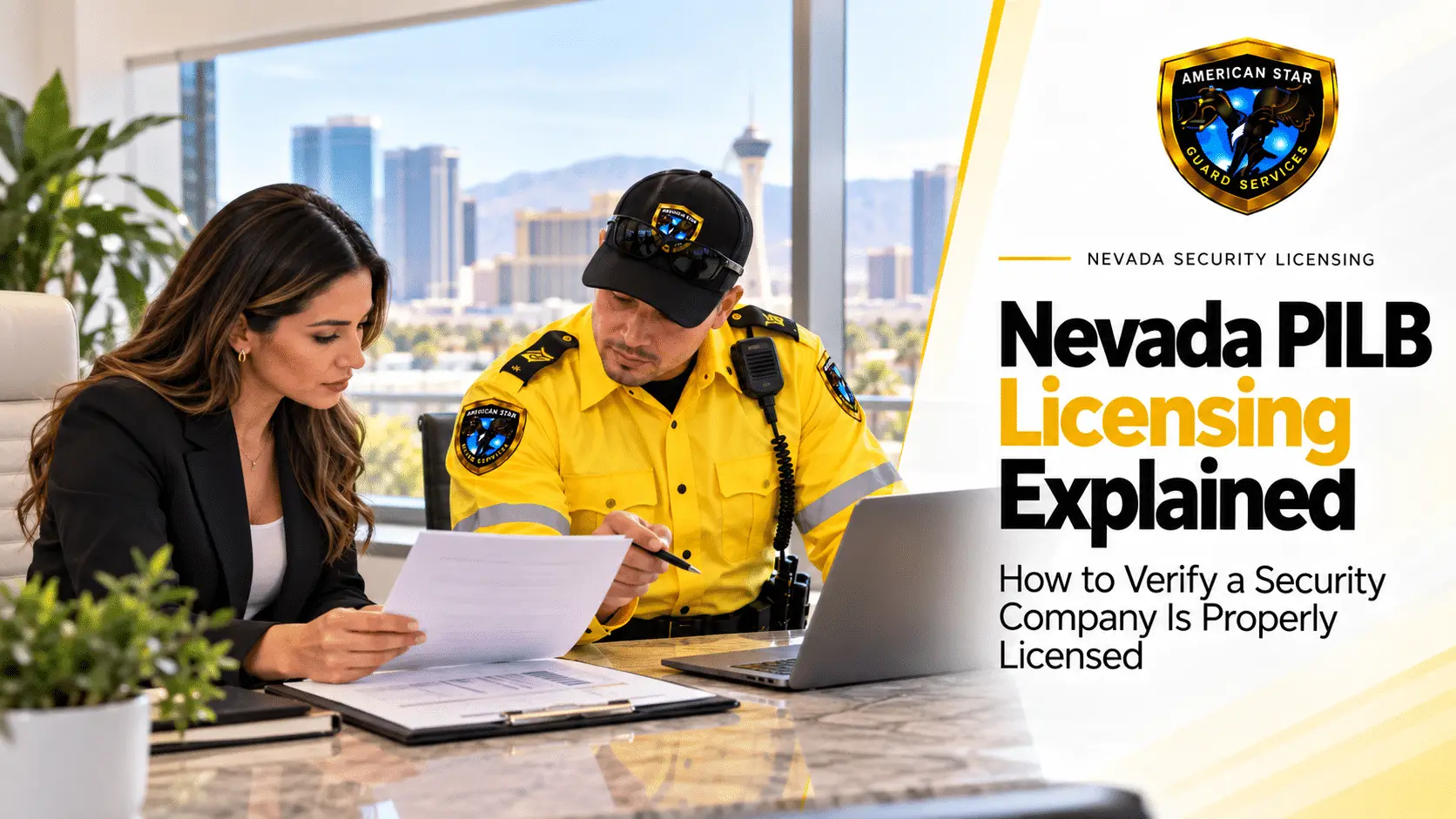
If you are about to hire a security company in Nevada, one question should come before price, before uniforms, and before any sales pitch: is this company actually licensed?
In Nevada, the answer runs through the Private Investigators Licensing Board, usually shortened to the PILB. The PILB is the state agency that regulates private investigators, private patrolmen (the legal term for security guard companies), process servers, repossessors, and related professions. If a company is providing security services in Nevada without the proper authorization, you could be exposed to legal, financial, and safety risks.
This guide explains Nevada PILB licensing in plain language: what the board does, which licenses and cards matter, how to verify a company yourself, what documents to request, and the red flags that should make you reconsider. It is written for business owners, property managers, event organizers, HOAs, and anyone else who buys security services. This is general information, not legal advice. For your specific situation, check the current rules with the PILB or consult an attorney.
What Is the Nevada PILB?
The Private Investigators Licensing Board is a Nevada state agency created under Nevada Revised Statutes (NRS) Chapter 648 and related administrative regulations in the Nevada Administrative Code. Its purpose is to protect the public by setting qualifications, monitoring compliance, and disciplining licensees who violate the rules.
The board licenses and oversees several categories, including:
- Private investigators
- Private patrolmen (security guard companies)
- Polygraph examiners
- Process servers
- Repossessors
- Security consultants
- Other related professions
For buyers of security services, the category that matters most is the private patrolman license, along with the individual credentials held by the security officers themselves.
Company License vs. Individual Guard Registration
One of the most common points of confusion is the difference between the company’s license and the officer’s credentials. Both matter.
The Company License
A security company operating in Nevada must hold a license to operate as a private patrolman. To qualify, the business must meet requirements set by law, which generally include:
- A qualified manager or licensee who meets experience and background standards
- Background checks and fingerprinting
- Proof of required insurance or financial responsibility
- Compliance with business and tax requirements
- Payment of licensing fees
The company license is what allows the business to legally sell security guard services to the public.
Individual Guard Registration (Work Card)
Security officers working for a licensed company must also be registered with the PILB and carry the required identification. Officers typically go through a background check and fingerprinting, and they must complete required training before they can be assigned to work. Armed officers have additional requirements, including firearms training and approval.
Registered officers carry a PILB-issued card or credential. Ask to see it. A legitimate company will not hesitate.
The key point: a company can hold a license while individual guards are not properly registered. Verifying only the company name is not enough.
Why PILB Licensing Matters to Your Business
Licensing may look like paperwork, but it protects you in practical ways.
It Confirms Basic Qualifications
Licensing includes background screening and requirements for those who run the company and staff the posts. It filters out many people with disqualifying histories.
It Affects Your Liability and Insurance
If an unlicensed guard injures someone, damages property, or is involved in a use-of-force incident, your business could face serious questions. Insurers may deny claims or contest coverage if the security provider was operating unlawfully. In the event of a lawsuit, hiring an unlicensed vendor can be portrayed as negligence.
It Gives You Recourse
Licensed companies are subject to board oversight. If a licensee violates the rules, the PILB can investigate, fine, suspend, or revoke licenses. That is a level of accountability an unlicensed operator does not have.
It Is Often Required by Others
Venues, property owners, government agencies, and insurers frequently require proof of a valid Nevada security license. Convention centers and major resorts, for example, will ask for it before allowing an outside firm to work. Learn more in our guide to convention and trade show security in Las Vegas.
How to Verify a Nevada Security Company Step by Step
You do not need to be an expert to check. Follow this process before you sign any contract.
Step 1: Ask for the License Information
Request the company’s PILB license number and the exact legal name of the licensee. Make sure the name on the license matches the name on the proposal, the contract, and the insurance certificate. Mismatches can mean the company is using another firm’s license or operating under a name that is not authorized.
Step 2: Check the PILB Database
The PILB provides a way to look up licensees through its official website. Search by company name or license number and confirm:
- The license exists and is active
- The license type is appropriate (private patrolman)
- The license is in good standing, with no suspension or revocation
- The expiration date has not passed
- The business address and qualified manager match what the company told you
Use the official state source rather than a screenshot or a PDF the company sends you. Documents can be outdated or altered.
Step 3: Verify Officer Credentials
Ask that the officers assigned to your site hold current PILB registration. You can request a roster and confirm cards on site. For armed assignments, ask for proof of the additional firearms authorization.
Step 4: Confirm Insurance
Ask for a certificate of insurance and check that:
- The policy is current and covers security guard operations
- Limits meet your requirements or your venue’s requirements
- The named insured matches the licensed company
- Your business is listed as an additional insured if needed
Call the insurance agent listed on the certificate if you want to confirm the policy is active.
Step 5: Review the Contract
Make sure the contract identifies the licensed company, lists the services and rates, addresses insurance and indemnification, and does not allow the company to subcontract your work to an unlicensed third party without your approval.
Step 6: Check the Company’s Reputation
Look at reviews, ask for references, and search for any public disciplinary history. A license is a minimum standard, not a guarantee of quality.
Red Flags: Signs a Security Company May Not Be Properly Licensed
Watch for these warning signs.
- The company will not provide a license number, or gives a vague answer.
- The name on the license does not match the name on the contract or insurance.
- The license is expired, suspended, or inactive when you check the database.
- Guards cannot show a registration card when asked.
- The price is dramatically lower than the rest of the market. Some unlicensed operators undercut competitors because they avoid the costs of compliance.
- The company relies on subcontractors it cannot identify or verify.
- The company is based out of state and cannot show Nevada authorization.
- Guards are working without required training or uniform standards.
- The company pressures you to sign quickly without documentation.
If you see any of these, pause and ask more questions before proceeding.
Out-of-State Security Companies Working in Nevada
Major events in Las Vegas often attract security companies from other states. Being licensed elsewhere does not automatically allow a company to work in Nevada. Nevada requires private patrolmen operating in the state to be properly licensed here, though the details of how out-of-state firms qualify or partner with Nevada licensees can vary. If a vendor tells you they are “licensed nationwide,” ask them to show the specific Nevada authorization and confirm it with the PILB.
Armed Security in Nevada
Armed officers involve added layers of regulation, including firearms training, qualification, and authorization. Nevada also has laws about where firearms can be carried, and venues such as casinos, convention centers, and schools have their own restrictions.
If you need armed officers, verify:
- The company is authorized to provide armed services
- Each armed officer holds the required firearms permit or authorization
- The armed officers have current qualifications
- The insurance policy covers armed operations
Armed service is more expensive and carries more risk, so use it only where the risk profile justifies it.
Who Is Responsible If You Hire an Unlicensed Guard Company?
The legal consequences depend on the facts, but potential exposure includes:
- Regulatory attention. Businesses that knowingly hire unlicensed providers may draw scrutiny, and the unlicensed provider can be subject to penalties.
- Insurance disputes. A claim involving an unlicensed provider can be complicated or denied.
- Civil liability. If someone is harmed, you may be blamed for failing to do due diligence.
- Contract problems. Some property, venue, or government agreements require licensed security. Violating them can breach your contract.
Doing a five-minute verification is a small step that can prevent very large problems.
Questions to Ask Any Nevada Security Company
Use these questions in your vendor evaluation:
- What is your Nevada PILB license number, and who is your qualified manager?
- Can I see current registration for each officer you will assign to my site?
- Are you licensed to provide armed services, if I need them?
- What insurance do you carry, and can I be added as an additional insured?
- Do you use subcontractors? If so, are they licensed in Nevada?
- How do you train and supervise your officers?
- How do you handle incident reporting?
- Can you provide references from clients like mine?
- What is your process for replacing a guard who is not working out?
- Have you ever had a license suspension, fine, or disciplinary action?
Honest, prepared companies welcome these questions.
Licensing Is the Minimum, Not the Whole Picture
A valid PILB license tells you a company meets legal requirements. It does not tell you how good the company is. Once you have confirmed licensing, evaluate the factors that determine day-to-day quality:
- Training and professionalism of the officers
- Supervision and management responsiveness
- Reporting quality and communication
- Reliability, including staffing and call-off coverage
- Experience with your industry, whether that is retail, events, construction, healthcare, or property management
- Cultural fit with your team and customers
American Star Guard is a Nevada-licensed provider offering security guard services for businesses, events, and communities across the Las Vegas area. We are happy to share our licensing and insurance information at the start of any conversation. To talk through your security needs, contact us.
Frequently Asked Questions
What does PILB stand for?
PILB stands for the Private Investigators Licensing Board, the Nevada state agency that licenses and regulates private investigators, private patrolmen (security companies), and related professions.
Is a Nevada security guard company license the same as a guard card?
No. The company license authorizes the business to operate. Individual officers must also be registered and carry their own PILB credential. You should verify both.
How can I check if a security company is licensed in Nevada?
Ask for the license number and legal business name, then search for the company on the PILB’s official website. Confirm that the license is active, in good standing, and matches the name on your contract.
Can a company from another state provide security in Las Vegas?
Only if it meets Nevada’s requirements. Being licensed in another state does not by itself authorize work in Nevada. Ask for proof of Nevada authorization and verify it with the PILB.
What happens if I hire an unlicensed security company?
You may face insurance complications, civil liability if an incident occurs, and possible contract issues. The unlicensed provider may face penalties. Consult an attorney for your specific circumstances.
Do all security guards in Nevada need a work card?
Security officers working for a licensed private patrolman in Nevada must meet the PILB’s registration requirements. Check the current rules with the PILB, since regulations can change.
Should I hire the cheapest licensed security company?
Not automatically. Low pricing can signal thin training, poor supervision, and high turnover. Compare what each proposal includes, not just the hourly rate.
Final Thoughts
Nevada PILB licensing is the first filter every business should apply when choosing a security provider. Verify the company license, confirm the officers’ registrations, check the insurance, read the contract carefully, and watch for red flags. Doing so protects your people, your property, and your business.
If you would like a licensed, insured Nevada security partner and want to see our credentials up front, reach out to American Star Guard.
Related reading: Convention and Trade Show Security in Las Vegas | Security Guard Services | Armed Security Guards
This article provides general information and is not legal advice. Licensing requirements can change. Confirm current rules with the Nevada PILB.
More from American Star Guard: How to Choose the Best Security Company in Las Vegas | Guide to Hiring Unarmed Security Guard Services in Las Vegas | Fire Watch Services
Pingback: Convention & Trade Show Security in Las Vegas Guide