
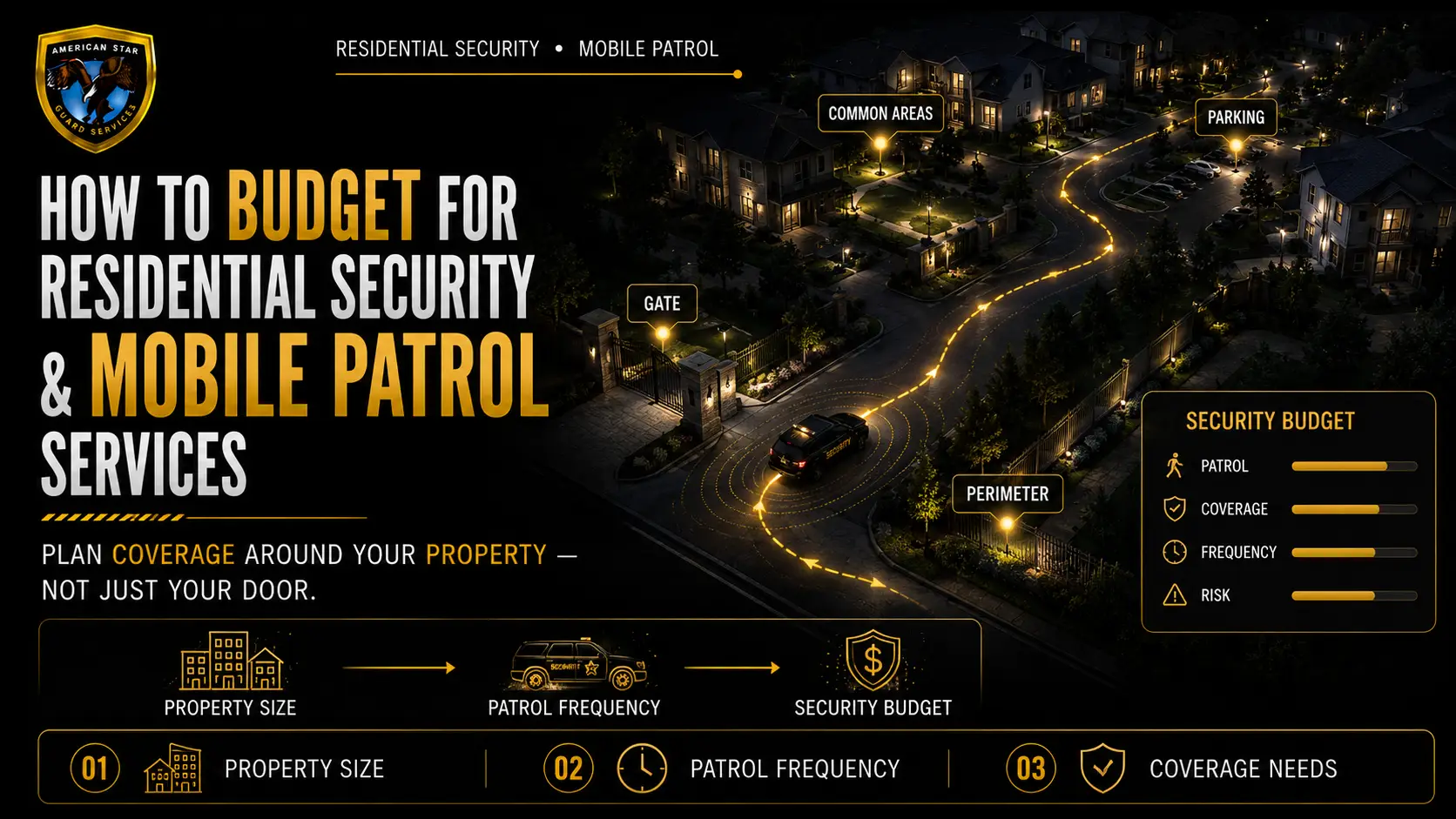
How to Budget for Residential Security and Mobile Patrol Services is an important planning topic for Las Vegas and Southern Nevada. The right approach starts with the actual needs of the community, then connects those needs to practical security services, measurable responsibilities, and a budget that boards and property managers can understand. For HOAs and residential communities considering security officers, mobile patrol, access control, parking-lot patrol, and temporary fire-watch coverage, the goal should not be to purchase the largest possible package. It should be to build an appropriate security model around risk, resident traffic, access points, and response expectations. This guide explains how to evaluate the issue, compare options, plan spending, and review performance so that security decisions remain aligned with the community’s actual needs.
Many HOA boards approach the security budget the same way they’d approach landscaping or pool maintenance — as a fixed annual cost decided once and left alone. Security doesn’t work that way. Resident populations change, incident patterns shift, and the areas of the community that need attention this year may not be the same ones that needed it two years ago. A budget process built around a genuine assessment of the community, rather than last year’s number with a small adjustment, produces a plan the board can actually defend to residents when questions come up.
Define the Objective
Before setting a number, define what the community actually needs security to accomplish. Is the goal deterring break-ins, controlling gate access, reassuring residents after a recent incident, or meeting an insurance requirement? An HOA board that agrees on the objective first can evaluate proposals against that goal, rather than simply comparing sticker prices between vendors.
This step also helps manage resident expectations. If the board’s objective is primarily deterrence and visible presence, that should be communicated clearly, since residents sometimes expect a security program to prevent every possible incident regardless of scope. Being explicit about what the program is and isn’t designed to address reduces friction later when an incident occurs that falls outside the plan’s intended coverage.
Assess the Property or Business
Walk the community with an eye for vulnerable points: gated entrances, parking areas, mailrooms, pool and common areas, and any spots where residents or visitors move in and out. Note the number of units, entrances, and typical resident and guest traffic. A 40-unit townhome community and a 400-unit high-rise complex call for very different coverage models, even if both are technically “residential.”
This walkthrough is most useful when it includes someone who will actually be accountable for the security relationship going forward, whether that’s a board member, property manager, or management company representative. Physical layout details that seem minor on paper — a poorly lit side entrance, a mailroom with no camera coverage, a parking structure with a blind corner — often surface only when someone experienced in security walks the property in person.
Identify the Highest-Risk Areas
Certain spots in a residential community consistently see more activity than others — parking structures, mail and package areas, and unmonitored side entrances are common examples. Identifying these upfront lets the board direct security spending toward the areas that actually generate resident complaints and incidents, instead of spreading coverage evenly across low-risk and high-risk zones alike.
Package theft in particular has become one of the most common resident complaints across residential communities, driven by the volume of deliveries most households now receive weekly. Communities that identify this as a specific risk area can budget targeted solutions — camera coverage, secured package rooms, or patrol timing aligned with typical delivery windows — rather than treating it as an unavoidable cost of modern living.
Review Operating Hours
Residential communities don’t have “business hours” in the traditional sense, but risk still shifts throughout the day. Late-night and early-morning hours typically see the least foot traffic and the highest vulnerability. Structure coverage — whether stationed, patrol, or a mix — around when residents are actually present versus when the property is quiet and less monitored.
Weekend and holiday patterns also matter here. A community with a strong daytime presence during the week may see very different activity on weekends, when more residents and guests are around common areas at different hours. Reviewing these patterns rather than assuming a flat weekly schedule helps the board avoid both overpaying for coverage during genuinely low-risk hours and underpaying during periods that actually need it.
Separate Fixed and Flexible Coverage
A gatehouse staffed during peak hours is a fixed, predictable cost. Additional patrols during a holiday season, a spike in package theft, or a community event are flexible needs. Keeping these separate in the budget makes it easier for the board to approve extra coverage temporarily without renegotiating the community’s core security contract.
This distinction also makes it easier to communicate the budget to residents at an annual meeting. A board that can point to a stable core coverage cost, plus a modest flexible allocation for situational needs, presents a far more credible and manageable picture than one asking for a large, unexplained lump sum.
Match Services to Tasks
Not every part of a community needs the same type of coverage. A staffed gatehouse suits a community with a single controlled entrance. Mobile patrol suits sprawling townhome communities or multiple smaller properties under one HOA. Access control technology can handle routine resident and visitor entry without staffing a post at all. Choosing the right tool for each specific need keeps the budget from ballooning unnecessarily.
Larger master-planned communities often benefit from a layered approach — a staffed gatehouse at the main entrance, combined with mobile patrol covering the interior streets and common areas, and access control technology managing secondary entrances that don’t justify full-time staffing. This layered model is frequently more effective, and often more affordable, than trying to staff every access point at the same level.
Compare Staffing Options
Most residential communities are well served by unarmed officers trained in visitor management and de-escalation, though some higher-risk properties may consider armed coverage. Compare options honestly against the community’s actual incident history rather than assumptions, and involve the HOA board in understanding what each staffing level actually provides.
It’s worth discussing staffing options openly with residents as well, particularly if the community is considering a change from its current model. Some residents associate a larger, more visible security presence with greater safety regardless of whether it actually addresses the community’s specific risks, and a board that can explain its reasoning tends to face less pushback than one that simply announces a decision.
Consider Patrol Coverage
For many communities, mobile patrol offers the best balance of cost and coverage — a marked vehicle making scheduled and randomized passes through parking areas and common spaces. Patrol frequency should reflect the property’s actual risk level and size rather than a flat, generic schedule applied regardless of community needs.
Patrol reporting is worth specifying clearly in the contract. Boards should expect a documented log of each pass, including timing and any observations, so the community has a real record to review rather than simply trusting that patrols occurred as scheduled.
Plan Access Control
Gate credentials, keycard entry, and visitor management systems are core to most residential security plans. Budget not just for the hardware but for who manages it — issuing resident credentials, handling lost cards, and updating access lists as residents move in and out. An access system with no one actively managing it quickly becomes a security gap rather than a safeguard.
Turnover is a particular vulnerability for residential access control. When a resident moves out, their credentials need to be deactivated promptly, and this administrative task is easy to overlook without a clear process assigned to someone specific, whether that’s the property management company or the security provider itself.
Include Parking and Perimeter Needs
Parking areas and community perimeters are among the most common sites for vehicle break-ins and unauthorized entry in residential settings. Budget for lighting, patrol coverage of these specific areas, and any fencing or barrier needs as its own line item, separate from whatever coverage exists at the main gate or clubhouse.
Visitor parking areas in particular deserve specific attention, since they’re often less monitored than resident-assigned spaces and see a higher volume of unfamiliar vehicles. A community that budgets for visitor parking coverage as a distinct concern, rather than assuming it’s covered by general patrol, typically sees fewer incidents in that specific area.
Budget for Temporary Requirements
Community events, seasonal spikes in visitor traffic, or a temporary need for fire watch during system maintenance all call for short-term coverage beyond the standard plan. Setting aside budget for these situations in advance prevents the board from having to make a rushed decision when a need comes up unexpectedly.
Large community events — holiday gatherings, pool parties, or annual meetings — are a common trigger for temporary coverage needs, since they bring higher visitor volume and parking demand than a typical day. Planning for this in advance, rather than scrambling before each event, keeps both cost and logistics manageable.
Account for Supervision
Security officers working without oversight are harder for a board or property manager to hold accountable. Budget for supervision — whether through a dedicated account manager, scheduled site visits, or a reporting system the HOA board can review — so the community has real visibility into how the security program is performing.
For volunteer HOA boards especially, having a responsive account manager on the provider’s side matters significantly. Board members typically have limited time to manage day-to-day security operations themselves, so a provider that proactively communicates issues and performance, rather than waiting to be asked, reduces the burden on board volunteers considerably.
Require Clear Reporting
Boards and property managers need documentation they can actually use: incident logs, patrol records, and access activity. Build clear reporting expectations into the contract from the start, including how often reports are delivered and what detail they include, so the community has a real record to reference if an incident or dispute arises.
Regular reporting also gives the board something concrete to share with residents, which helps build confidence in the security program over time. A board that can point to specific patrol counts, incident resolutions, and access activity at an annual meeting presents a far stronger case than one relying on general reassurances.
Compare Vendors on Equal Scope
When comparing residential security proposals, make sure every vendor is quoting the same coverage: identical hours, staffing type, and patrol frequency. A lower quote often means reduced coverage, not better value. Ask each vendor for an itemized breakdown so the board can compare like for like.
It’s also worth asking each vendor about their experience specifically with residential and HOA clients, since the skill set differs somewhat from commercial security. Officers working in a residential setting need strong interpersonal skills for interacting with residents day to day, not just enforcement and monitoring capability.
Use Incident Data
If the community has a history of specific incidents — package theft, vehicle break-ins, unauthorized access — use that data to shape the budget rather than starting from scratch. Recurring problems in a specific area point directly to where additional coverage will have the most impact for residents.
Boards that don’t currently track incidents in any organized way should consider starting a simple log immediately, even informally. A year of consistent data makes the next budget cycle a far more evidence-based conversation than relying purely on resident complaints or board members’ general impressions.
Create a Contingency
Even a modest contingency line gives the board flexibility to respond to a security need that wasn’t anticipated in the annual budget — an incident, a temporary safety concern, or an unplanned community event. Having this pre-approved avoids delays caused by an emergency board vote.
This is particularly important for HOA boards, where emergency spending often requires a special vote or resident notification depending on the community’s governing documents. A pre-approved contingency line lets the board or property manager act quickly on a genuine security need rather than waiting on a procedural approval process.
Review Seasonal Demand
Resident and visitor activity often shifts seasonally — more guests and package deliveries during the holidays, more pool and common-area use in summer. Build this seasonal variation into the security budget rather than applying flat coverage year-round regardless of actual community activity.
Communities in warmer climates, including much of Southern Nevada, often see extended outdoor and pool activity through more of the year than communities elsewhere, which should factor into how the board thinks about seasonal coverage needs rather than assuming a short summer spike model.
Measure Performance
A residential security budget should be tied to outcomes the board can actually see: incident counts, patrol completion, and resident feedback. Use these metrics at each budget cycle to evaluate whether current spending is delivering real results for the community.
Resident feedback, gathered informally or through a simple survey, is a useful complement to hard incident data. A community may have low incident counts but still have residents who feel the security presence is inconsistent or unresponsive, and that gap is worth understanding before the next budget cycle.
Coordinate With Finance and Operations
Security spending is part of the community’s broader budget, alongside landscaping, maintenance, and reserves. Loop in the HOA’s finance committee or management company early so security isn’t treated as an isolated line item disconnected from the community’s overall financial planning.
This coordination matters especially when a community is also managing reserve fund requirements or planning capital improvements. Security spending decisions made in isolation from the broader financial picture can create unexpected conflicts with other budget priorities later in the year.
Review the Plan Annually
Communities change — new residents move in, common areas get renovated, incident patterns shift. An annual review of the security plan ensures the coverage still matches the community’s actual needs rather than reflecting assumptions from years earlier.
This annual checkpoint is also a natural time to solicit resident input, whether through a survey or an open discussion at the annual meeting. Residents often have direct, ground-level observations about security gaps that don’t reach the board through any other channel.
Turn the Budget Into an Action Plan
A budget only helps once it becomes a real plan: who is staffing the gate, what technology is being installed, and by when. Convert each line item into a specific action so the board’s approved budget translates into actual coverage residents can see and rely on.
Communicating this action plan to residents, even in brief form, helps build trust that the budget approved at the annual meeting is actually being implemented as promised, rather than residents wondering months later whether anything changed.
Practical Planning Checklist
- Document current coverage and security gaps.
- Identify high-risk locations and time periods.
- Define the service and response level required.
- Compare proposals using the same scope.
- Include supervision, reporting, and contingency needs.
- Review performance and incident data.
- Revisit the plan when the property or business changes.
Frequently Asked Questions
Is mobile patrol a good fit for residential communities?
It can be useful when a community needs regular physical checks and deterrence but does not require a guard to remain at one location continuously.
How should an HOA compare security proposals?
Require each provider to show coverage hours, duties, patrol frequency, supervision, reporting, response expectations, and additional charges.
What affects residential security cost?
Property size, entrances, parking, activity patterns, required coverage, patrol frequency, officer type, and temporary needs all affect cost.
Should communities budget for emergencies?
A controlled contingency can help cover temporary patrols, fire watch, special events, or emergency response without disrupting the recurring budget.
How often should an HOA revisit its security contract?
At least annually, alongside the broader budget cycle, and any time the community experiences a significant incident, a change in leadership, or a notable shift in resident population.
Conclusion
A strong residential security budgeting plan is based on the property’s actual requirements, not a one-size-fits-all formula. By defining risk, matching tasks to the right security layer, comparing service scope, and measuring performance, decision-makers can create a program that is easier to manage and defend.
For organizations in Las Vegas and Southern Nevada, security officers, mobile patrol, access control, parking-lot patrol, and temporary fire-watch coverage can be evaluated as part of a broader security strategy. The next step is a site-specific review that connects operational needs, risk, service scope, and budget.
A residential security budget should balance protection, resident expectations, accountability, and financial discipline rather than simply targeting the lowest possible price.