
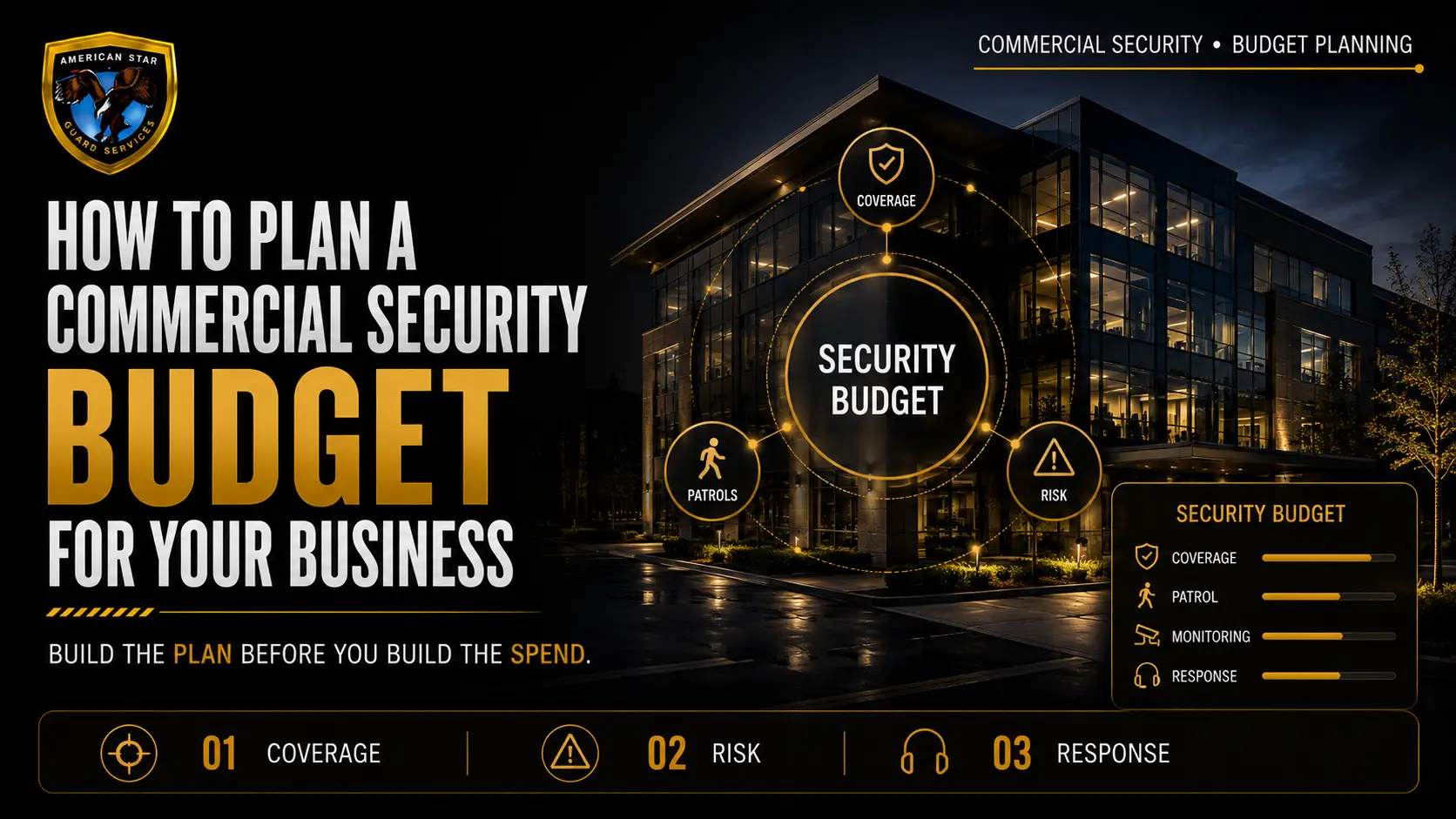
How to Plan a Commercial Security Budget for Your Business is an important planning topic for Las Vegas and Southern Nevada. The right approach starts with the actual needs of the property or business, then connects those needs to practical security services, measurable responsibilities, and a budget that decision-makers can understand. For organizations considering security officers, mobile security patrol, access control, parking-lot patrol, and fire watch, the goal should not be to purchase the largest possible package. It should be to build an appropriate security model around risk, operating hours, access points, people, property, and response expectations. This guide explains how to evaluate the issue, compare options, plan spending, and review performance so that security decisions remain aligned with business needs.
Too often, security budgets are built backward — a number gets set first, based on what “feels right” or what was spent last year, and services get fit into that number afterward. That approach tends to produce either overspending on generic coverage that doesn’t match the property’s actual risks, or underspending in the specific areas where an incident is most likely to occur. A better process starts with a clear-eyed look at the property itself, works through each layer of potential coverage, and only then arrives at a number — one that’s tied to specific, defensible reasoning rather than a rough guess.
Define the Objective
Before assigning a budget number, define what the security program is actually meant to accomplish. Is the priority deterring theft, controlling who enters the building, responding to incidents faster, or satisfying an insurance or lease requirement? Each objective points toward a different mix of services and a different spending level. A budget built around a clear objective is easier to defend to ownership or finance than one built around a vague sense that “more security is better.”
It’s worth writing this objective down explicitly and referring back to it throughout the planning process. A property manager focused on reducing after-hours break-ins will make different staffing decisions than one focused on managing high daytime visitor volume in a busy lobby. When the objective is vague, it becomes easy to overspend on visible measures that don’t actually address the underlying risk, or to underspend on the specific gap that’s driving the concern in the first place.
Assess the Property or Business
Walk the property with a critical eye: entrances, parking areas, loading docks, common spaces, and anywhere the public or vendors interact with the site. Note square footage, number of access points, hours of operation, and how many people move through daily. This assessment becomes the foundation for every staffing and technology decision that follows — a single-entrance office suite and a sprawling retail complex will never need the same security model.
This assessment should also account for the building’s age and layout. Older properties may have more entrances than are actively used, some of which may not be properly secured or monitored. Multi-tenant buildings introduce additional complexity, since access needs vary between tenants and shared spaces require coordination across multiple stakeholders. A thorough walkthrough, ideally involving whoever will actually manage the day-to-day security relationship, surfaces details that get missed when planning happens purely on paper.
Identify the Highest-Risk Areas
Not every part of a property carries equal risk. Loading docks, parking structures, after-hours entrances, and cash-handling areas typically see more incidents than a staffed front lobby during business hours. Ranking these areas by risk lets you concentrate budget where it matters most, rather than applying uniform coverage everywhere and diluting protection at the points that actually need it.
This ranking doesn’t need to be a formal risk assessment with weighted scoring, though larger properties may benefit from one. For most businesses, a straightforward conversation with staff and facilities personnel about where problems have occurred, or where they worry about problems occurring, is enough to build a reasonably accurate picture. The goal is simply to avoid the common mistake of spreading a fixed budget evenly across every part of the property when the actual risk is concentrated in two or three specific locations.
Review Operating Hours
Security needs shift dramatically between business hours and after-hours periods. A property that’s fully staffed and busy at 2 PM may be completely empty and vulnerable at 2 AM. Map coverage against your actual operating schedule — including seasonal or weekend variations — rather than budgeting for flat, round-the-clock coverage by default when a targeted after-hours plan may serve the property just as well at lower cost.
Businesses with irregular hours — extended retail hours during holidays, a manufacturing facility running weekend shifts, or a construction site with a shifting completion timeline — need a plan flexible enough to track those changes rather than a static schedule set once a year. Reviewing operating hours alongside the security plan on a recurring basis, not just at renewal time, helps catch mismatches before they become a real vulnerability.
Separate Fixed and Flexible Coverage
Some coverage needs are constant — a staffed lobby during business hours, for example — while others are situational, like extra coverage during a busy season or a one-off event. Budgeting these separately makes it easier to control costs: fixed coverage becomes a predictable line item, while flexible coverage can scale up or down without renegotiating the entire contract.
This separation also makes the annual budget conversation with finance or ownership more straightforward. Fixed coverage can be presented as a stable, forecastable cost, while flexible coverage can be framed as a variable allocation tied to specific triggers — a seasonal spike, a known event, or an emerging risk. That framing tends to get approved more easily than a single lump sum that bundles predictable and unpredictable costs together without distinction.
Match Services to Tasks
Different security tasks call for different tools. A stationed officer makes sense where continuous presence and interaction with visitors is needed. A mobile patrol suits large properties or multiple locations where periodic checks are sufficient. Access control technology handles routine credential verification without staffing a post at all. Matching the right tool to each specific task — instead of defaulting to the most visible or most expensive option — keeps the budget efficient.
A common mistake is assuming a stationed officer is always the strongest option, when in practice a well-designed access control system combined with periodic mobile patrol can deliver equivalent or better protection at a fraction of the cost for many properties. The right combination depends entirely on the specific tasks identified earlier in the planning process, not on which option looks most reassuring on paper.
Compare Staffing Options
Armed versus unarmed, full-time versus part-time, in-house versus contracted: each staffing decision carries a different cost and risk profile. Compare options against your actual threat level rather than assumptions. A property with no history of violent incidents rarely needs armed coverage, while a cash-handling business or high-profile site may need it regardless of past incident history.
In-house versus contracted staffing is its own significant decision. In-house security offers more direct oversight but comes with the full weight of hiring, training, licensing compliance, and liability. Contracted security shifts much of that administrative burden to the provider, typically at a predictable per-hour cost, which is why most commercial properties in Las Vegas rely on a licensed contracted provider rather than building an internal security department from scratch.
Consider Patrol Coverage
Mobile patrol is often the most cost-effective way to cover large properties, multiple buildings, or a portfolio of smaller sites that don’t individually justify a full-time guard. Patrol frequency should be based on the property’s risk level and size — a single nightly pass may suffice for a low-risk site, while a high-traffic commercial property may need several checks per shift.
Patrol schedules should also be randomized rather than fixed. A patrol that arrives at the same time every night becomes predictable, which reduces its deterrent value. A well-run patrol provider varies timing and route while still meeting the minimum frequency the property requires, and documents each visit with a time-stamped record the property manager can review.
Plan Access Control
Access control ranges from a simple keypad to a fully integrated credential and biometric system. Budget for both the technology itself and the ongoing management it requires — issuing and revoking credentials, monitoring alerts, and maintaining the hardware. A system with no one managing it in practice provides far less protection than the budget line implies.
Access control budgets are frequently underestimated because the upfront hardware cost is the only number decision-makers see initially. The recurring costs — software licensing, credential management, system maintenance, and eventual hardware replacement — need to be part of the budget from the start, not treated as a surprise expense two or three years into the system’s life.
Include Parking and Perimeter Needs
Parking lots and building perimeters are frequently overlooked in security budgets, even though they’re common sites for vehicle break-ins, loitering, and unauthorized access. Include lighting, patrol coverage, and any fencing or barrier needs as a distinct line item rather than assuming they’re covered by whatever staffing exists at the building’s main entrance.
Perimeter needs vary significantly by property type. A single-building office park may only need adequate lighting and periodic patrol checks, while a large industrial site or distribution center may require fencing, gated access, and dedicated perimeter patrol as a core part of the security plan rather than an afterthought.
Budget for Temporary Requirements
Construction phases, special events, system outages requiring fire watch, or a temporary spike in risk all call for short-term coverage outside your standard plan. Set aside a portion of the budget specifically for these situations so a temporary need doesn’t force a disruptive renegotiation of your core security contract.
Fire watch coverage is one of the most common temporary requirements businesses underestimate. Any time a fire suppression or alarm system goes offline for maintenance or repair, most jurisdictions require continuous fire watch until the system is restored. Having this anticipated in the budget, rather than treated as an emergency expense, prevents scrambling to arrange compliant coverage on short notice.
Account for Supervision
Security staffing without supervision is difficult to hold accountable. Budget for the oversight layer — whether that’s a dedicated supervisor, regular site visits from account management, or a reporting system that flags issues in real time. Supervision is what turns a staffing line item into an actual managed program.
Supervision costs are sometimes bundled into the hourly rate a provider charges and sometimes billed separately — it’s worth clarifying which model applies before comparing vendor quotes, since a lower headline rate with no included supervision can end up costing more once oversight is added as a separate line item.
Require Clear Reporting
Documentation — incident reports, patrol logs, access records — is what makes a security program auditable and improvable over time. Build reporting expectations into the budget conversation from the start: how often reports are delivered, in what format, and what specific information they need to include for your property.
Clear reporting also protects the business in the event of a dispute or liability claim. A well-documented security program, with time-stamped patrol logs and detailed incident reports, gives a business a defensible record to point to. A program that relies on verbal assurances with no paper trail leaves the business exposed if a serious incident is ever questioned.
Compare Vendors on Equal Scope
When comparing security proposals, make sure every vendor is quoting the same scope of work: identical hours, staffing levels, and duties. A lower price often reflects reduced coverage rather than better value. Request an itemized breakdown from each vendor so comparisons are based on equivalent service, not just a bottom-line number.
It also helps to ask each vendor directly what’s excluded from their quote. Supervision, reporting, equipment, and holiday staffing rates are common areas where quotes diverge significantly once the full scope is spelled out, and a business that skips this step often discovers the gap only after signing a contract.
Use Incident Data
If your property has any history of security incidents, use that data to guide the budget rather than starting from a blank slate. Recurring issues in a specific area, at a specific time, point directly to where additional coverage or technology will have the most impact.
Even informal incident tracking — a simple log kept by front desk or facilities staff — is valuable input here. Businesses that have never tracked incidents at all should consider starting now, since a year or two of consistent data makes the next budget cycle significantly easier to plan around actual risk rather than guesswork.
Create a Contingency
Set aside a contingency line — even a modest one — for security needs that emerge outside the annual plan. An unexpected incident, a new construction phase, or an unplanned event can all create short-term needs, and having contingency budget already approved prevents delays in responding.
A contingency of roughly 10 to 15 percent of the annual security budget is a reasonable starting point for many commercial properties, though the right figure depends on the property’s overall risk profile and how frequently unplanned situations have arisen in the past.
Review Seasonal Demand
Security needs often shift with the calendar. Retail properties may need more coverage during holiday shopping seasons, while some sites see increased risk during slower periods when fewer people are on-site. Build seasonal variation into the budget rather than treating security spending as flat across the year.
Seasonal planning should be revisited annually rather than assumed to stay the same. Shifts in foot traffic, new tenants, or changes in surrounding development can all alter a property’s seasonal risk pattern from one year to the next.
Measure Performance
A security budget should be tied to measurable outcomes, not just hours purchased. Track relevant metrics — incident counts, response times, patrol completion — and use them to evaluate whether the current spending level is actually producing the intended result.
Performance data also strengthens the case for budget requests going forward. A property manager who can show a measurable reduction in incidents after a security investment has a far easier time securing continued or increased funding than one presenting only a general sense that things “feel safer.”
Coordinate With Finance and Operations
Security decisions affect and are affected by broader business operations — staffing changes, new construction, shifting hours, or budget cycles. Loop in finance and operations early rather than presenting security spending as a standalone request disconnected from the rest of the business.
This coordination also helps security spending survive budget cuts. A security program that’s understood and supported by finance and operations, with a clear connection to business risk, is far less likely to be cut arbitrarily during a cost-reduction cycle than one that’s viewed as an isolated, poorly understood expense.
Review the Plan Annually
Properties change: tenants turn over, layouts get renovated, incident patterns shift. An annual review ensures the security budget still matches actual conditions rather than reflecting assumptions from years earlier that may no longer hold true.
This review is also the right time to revisit vendor performance, not just budget numbers. A provider that was a strong fit two years ago may no longer match the property’s current needs, and an annual review creates a natural checkpoint to make that assessment rather than defaulting to renewal out of habit.
Turn the Budget Into an Action Plan
A budget is only useful once it’s translated into an actual staffing and technology plan with clear responsibilities and timelines. Convert each budget line into a specific action — who is being hired or contracted, what technology is being installed, and by when — so the plan moves from a spreadsheet to real coverage on the ground.
Assigning a clear owner to each action item, with a realistic timeline, is what separates a budget document that sits in a drawer from one that actually results in improved security. Revisit this action plan at the same time as the annual budget review to confirm each item was actually completed.
Practical Planning Checklist
- Document current coverage and security gaps.
- Identify high-risk locations and time periods.
- Define the service and response level required.
- Compare proposals using the same scope.
- Include supervision, reporting, and contingency needs.
- Review performance and incident data.
- Revisit the plan when the property or business changes.
Frequently Asked Questions
How much should a business budget for security?
There is no universal number. The budget depends on property size, risk, operating hours, coverage requirements, and service mix.
Is mobile patrol useful for commercial properties?
It can be effective where periodic checks and visible deterrence are needed without continuous on-site staffing. The required response level should determine the model.
What should be compared between security vendors?
Compare scope, hours, duties, supervision, reporting, staffing reliability, licensing, insurance, response expectations, and total pricing.
When should a commercial security budget be reviewed?
At least annually and whenever the property changes, an incident occurs, operating hours change, or temporary security requirements arise.
Should a security budget include technology, or just staffing?
Both. Access control systems, cameras, and monitoring tools often reduce the staffing hours needed elsewhere, so evaluating them together typically produces a more cost-effective overall plan than budgeting for staffing and technology separately.
Conclusion
A strong commercial security budget plan is based on the property’s actual requirements, not a one-size-fits-all formula. By defining risk, matching tasks to the right security layer, comparing service scope, and measuring performance, decision-makers can create a program that is easier to manage and defend.
For organizations in Las Vegas and Southern Nevada, security officers, mobile security patrol, access control, parking-lot patrol, and fire watch can be evaluated as part of a broader security strategy. The next step is a site-specific review that connects operational needs, risk, service scope, and budget.
The best budget is the one that connects every major security expense to a defined risk, responsibility, and measurable outcome.